AI governance in a consulting firm is not just a policy about prompts. It connects the firm’s commitments to clients with the actual tools, data, workflows, and people involved in delivery.
The appropriate controls depend on the use case, the information involved, and the firm’s obligations. This guide is an operational starting point, not legal advice; firms should involve their own legal, privacy, security, and risk specialists where appropriate.
Create an inventory of uses
Keep a simple record of AI uses that affect firm operations or client work. For each use, name the business owner, users, tool and account, intended task, information types, reviewer, and current status.
An inventory helps distinguish an approved, bounded workflow from an informal experiment. It also makes it easier to find duplicated tools and identify where a change in vendor terms or product behavior needs review.
Define clear data boundaries
People need rules they can apply while doing the work. For example, the firm may distinguish public information, internal material, confidential client information, personal data, and restricted or regulated data. The exact categories and permissions must reflect the firm’s obligations and client agreements.
For each approved tool, document which data may be entered, whether inputs may be retained or used to improve services, who can access outputs, and how records should be handled. Verify the current vendor terms and configuration; do not assume that a product’s general privacy statement covers every plan or feature.
When in doubt, keep the information out until the appropriate owner gives clear direction.
Make human accountability visible
Assign a named person to approve each use case and establish who reviews important outputs. For client-facing work, the responsible professional should understand the evidence and remain accountable for the advice, analysis, and commitments delivered.
Review instructions should describe what to check, not merely say “review the output.” Depending on the task, that may include checking facts against primary sources, confirming calculations, testing whether a summary omitted qualifications, and verifying that an answer is relevant to the specific client.
Classify use cases by impact
Simple internal formatting and high-impact client decisions do not need identical treatment. Consider what happens if an output is wrong, who may be affected, whether sensitive information is involved, and how much human judgment the task requires.
A practical review can ask:
- Could a wrong result affect a client decision or outcome?
- Does the workflow handle confidential or personal information?
- Can a reviewer independently check the output?
- Is the tool making or materially influencing a consequential recommendation?
- Is there a safe manual fallback?
Higher-impact uses generally require stronger review, narrower access, and clearer approval before deployment.
Govern vendors and change
Record which product, account tier, and settings are approved. Assign someone to review material changes to data handling, access controls, integrations, or model behavior. Keep an exit path: how to export or remove firm information, stop the workflow, and continue the underlying work.
Training should cover the approved workflow and its limits. A one-time launch session is not enough if tools, terms, and practices change.
Monitor and improve
Create a simple route for staff to report errors, unexpected data exposure, unsafe outputs, or confusing behavior. Triage reports, record the response, and decide whether the use should continue, change, or stop.
Review the inventory and controls periodically. Useful signals include repeated corrections, exceptions, usage outside approved accounts, unclear ownership, or a change in client requirements.
Turn governance into an enabler
Good governance reduces ambiguity. It tells teams where they can experiment, where they need approval, and who can help when a workflow does not fit the rules. Start with a defined task, document the boundaries, and learn from a supervised pilot.
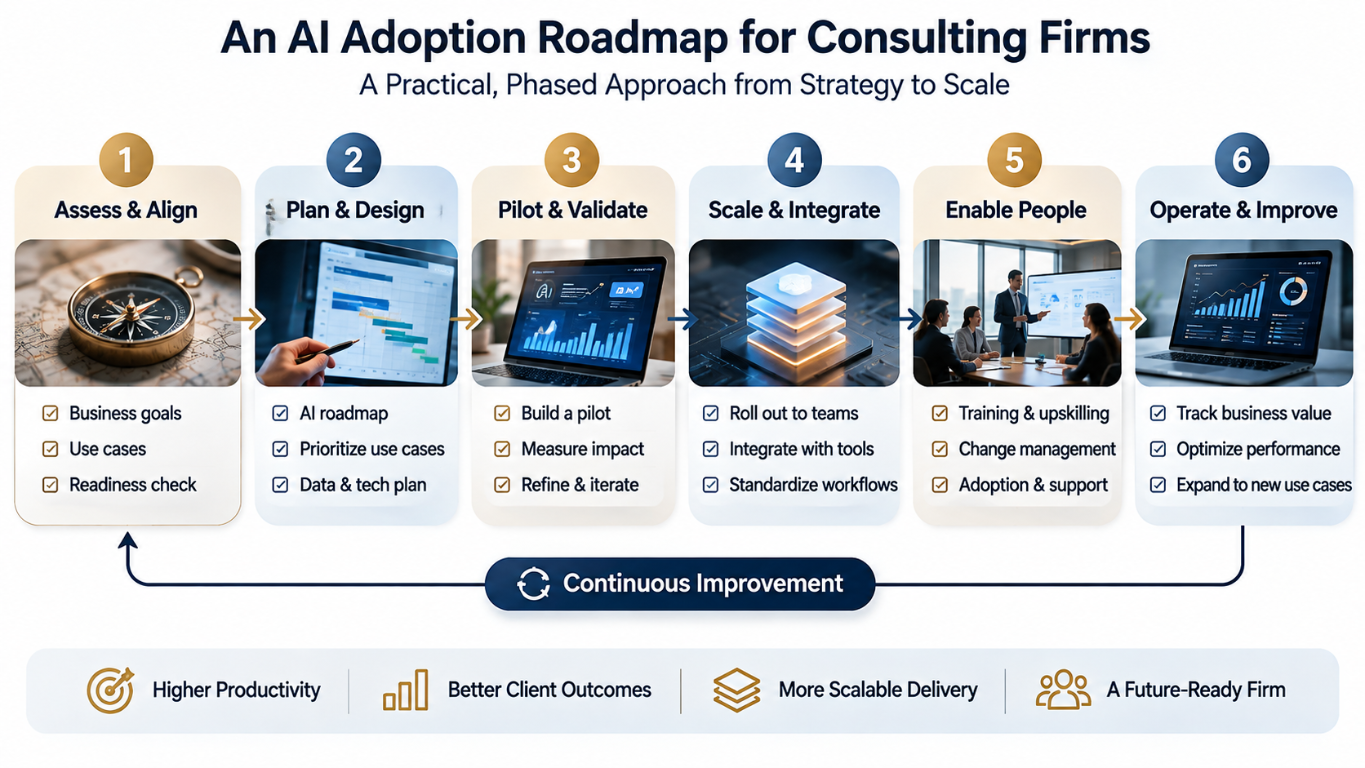
For a phased rollout that puts these controls into practice, see the AI adoption roadmap for consulting firms.