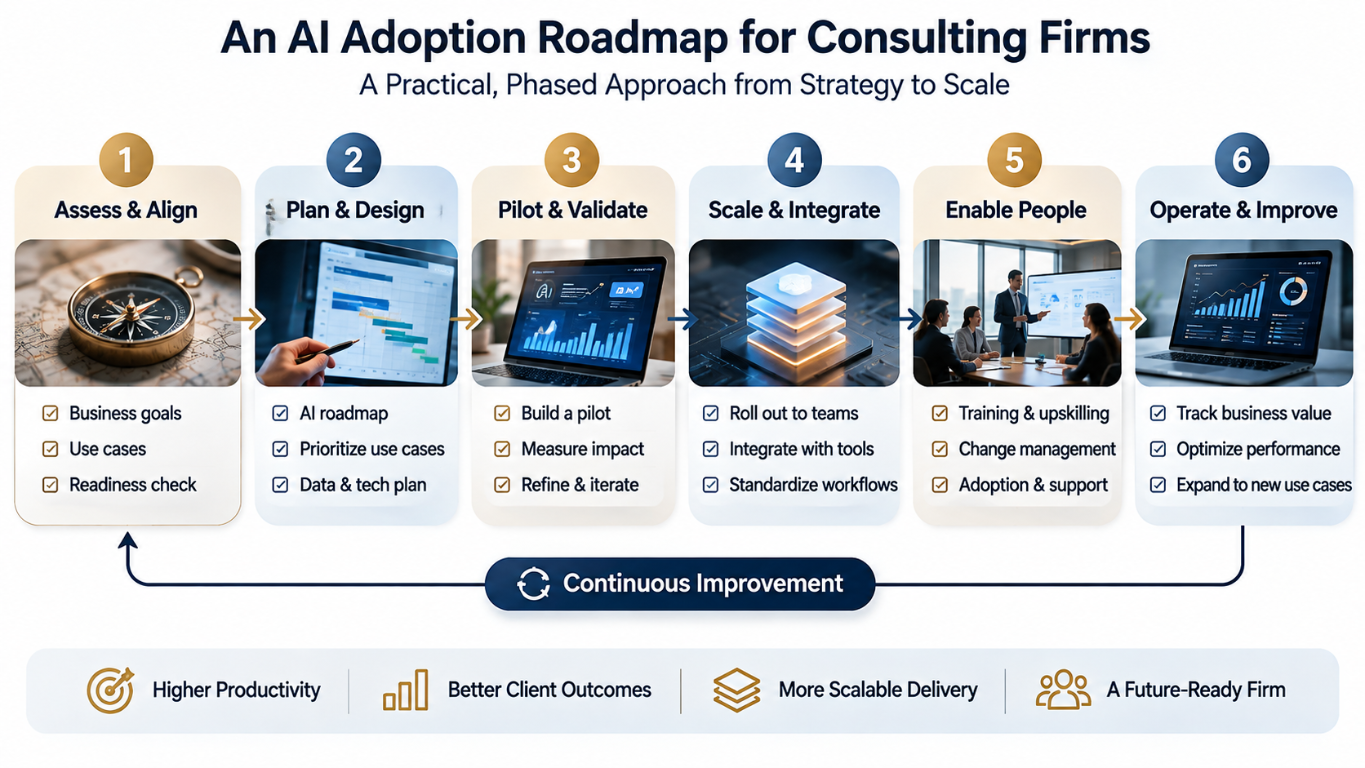
AI adoption in a consulting firm is not a license purchase followed by a launch email. It is a change to how people research, prepare, analyze, communicate, and deliver work. A useful roadmap starts with a specific workflow and keeps the people accountable for the work in the loop.
The sequence below is designed for firms that want to learn without committing client data or delivery quality to an untested system.
1. Choose a task before choosing a tool
List repetitive activities that consume meaningful time but have clear review criteria. Examples might include summarizing an internal meeting, classifying a set of approved research notes, drafting a first outline from a consultant’s own material, or finding relevant passages in a permissioned knowledge base.
For each candidate, describe:
- Who does the task and how often?
- What information can the person use?
- What does a correct, useful result look like?
- Who checks the result before it reaches a client or changes a decision?
- What is the current time, effort, and error pattern?
Avoid starting with high-stakes recommendations or an open-ended promise to “use AI everywhere.” A bounded task makes it possible to define acceptable quality and a safe fallback.
2. Establish the data and review boundaries
Before a pilot, confirm which tools and data uses the firm permits. Client contracts, confidentiality commitments, privacy obligations, professional rules, and the vendor’s current terms may all matter. A general-purpose account should not be assumed appropriate for confidential work.
Write down the pilot’s boundaries in plain language: permitted information, prohibited information, approved tool and account, human reviewer, retention expectations, and escalation path. Keep a manual route available so the work can continue if the tool is unavailable or produces an unusable answer.
For guidance on the controls themselves, see AI governance for consulting firms.
3. Design the workflow, not just the prompt
Map the complete task from input to approved output. A simple workflow might look like this:
- A consultant selects source material they are authorized to use.
- The AI creates a draft summary and points back to the source passages.
- The consultant checks quotations, names, figures, context, and omissions against the original.
- The reviewer edits or rejects the draft and records any recurring failure.
- Only the approved version is used in the next step of the engagement.
Be explicit about where the tool is allowed to assist and where a person must make the judgment. Good process design makes verification part of the task instead of treating it as optional cleanup.
4. Run a small, time-boxed pilot
Use a representative set of work that the firm is allowed to process. Include ordinary cases and known difficult cases. Agree in advance on what constitutes acceptable output, how exceptions are recorded, and when the team will stop and review the pilot.
Do not use a polished demonstration as proof of production readiness. Try realistic inputs, test handoffs, and note the extra effort needed to correct errors. Ask participants whether the workflow made the work clearer and more manageable—not only whether the generated text looked fluent.
5. Measure the result and decide what to do next
Compare the pilot with the existing process. Useful measures may include:
- Time from approved input to reviewed output.
- Reviewer edits and material corrections per task.
- Frequency of unsupported claims or missing context.
- Adoption by the people who actually do the work.
- Rework, client impact, or process exceptions.
The number of prompts sent is not a business outcome. A time saving is only useful if quality holds and the saved time can be put to better use. The AI ROI measurement guide shows how to build a simple before-and-after case.
A practical 30–60–90 day sequence
| Period | Focus | Evidence to collect |
|---|---|---|
| First 30 days | Select the workflow, confirm boundaries, define a baseline | Task volume, current time, reviewer criteria, permitted data |
| Days 31–60 | Pilot with a small group and a named reviewer | Quality checks, correction effort, exceptions, staff feedback |
| Days 61–90 | Decide to stop, adjust, or expand carefully | Repeatable results, owners, training needs, operating cost |
These are planning intervals, not a guarantee of adoption speed. A regulated or complex workflow may need more time and review.
Common failure modes
Starting with a broad mandate. Teams cannot tell what success means, and local experiments become difficult to compare. Begin with a workflow and an owner.
Treating fluent output as verified output. A readable answer can still omit a qualification, misstate a fact, or invent a source. Check it against material the firm trusts.
Skipping adoption work. Training, templates, review time, and manager expectations shape whether the process survives beyond a demonstration.
Scaling before learning. A successful task in one context is not automatically suitable for a different client, data class, or service line.
The decision is about the service
An adoption roadmap is successful when it improves a meaningful part of client service or firm operations without weakening confidentiality, quality, or accountability. Keep the scope narrow enough to learn, make review visible, and expand on evidence rather than excitement.
For more on the controls that support this approach, continue to AI governance for consulting firms and the consulting technology stack.