
AI ROI is easy to overstate when a business case counts the minutes a tool appears to save but ignores review, rework, setup, and the cost of operating the new workflow. A better assessment starts with a specific task and reports what was measured, what was estimated, and what remains uncertain.
Define the unit of work
Choose a task with a clear start and finish, such as preparing a first draft of an internal research summary or assembling an approved set of proposal materials. Avoid combining different activities into one broad “consultant productivity” number.
Describe the task, the people involved, the expected quality, the data used, and the frequency. If the task differs by engagement type or experience level, record that before comparing results.
Establish a baseline
Observe the current process for a representative period. Record active work time, waiting time, review effort, correction effort, output quality, and common exceptions. A baseline based on memory or a single demonstration is unlikely to support a reliable decision.
Use a sample that resembles real work. Note where the sample is unusually simple, unusually difficult, or incomplete.
Count the full cost
For an AI-assisted workflow, include:
- Time spent preparing inputs and managing the tool.
- Human verification, editing, and approval.
- Training and workflow design.
- Integration, access, and administration.
- Subscription or usage charges.
- Ongoing quality checks, support, and updates.
- Exceptions and work returned to the original process.
Then compare the total effort and cost with the baseline. A quick first draft can still be a poor investment if verification takes longer than the original task or the output is not reliable enough to use.
Evaluate quality alongside speed
Choose quality checks that match the work. They may include factual accuracy, source traceability, completeness, client relevance, or the frequency of material corrections. Ask an experienced reviewer to assess samples using consistent criteria.
If a workflow becomes faster but creates more mistakes or reduces the time available for careful review, it has not delivered a straightforward productivity improvement. Report the trade-off rather than hiding it inside an average.
Separate measured value from potential value
Time released is not automatically cash saved. It may be redirected to client work, business development, learning, or reduced overtime; each outcome has different value and evidence.
Separate the business case into:
- Observed changes: measured time, cost, quality, or cycle-time differences.
- Operational interpretation: what the team did with any capacity released.
- Potential benefits: future revenue, client experience, or risk reduction that still needs validation.
Do not multiply every saved minute across every employee and assume it becomes billable revenue. That is a scenario, not an observed return.
Use a transparent calculation
A simple first-year view can be expressed as:
Net benefit = measured annualized value of the workflow change − setup and operating costs
If the firm can estimate financial value for a verified capacity change, show the conversion assumptions separately. A scenario table is often more informative than a single ROI percentage:
| Scenario | What it assumes | How to use it |
|---|---|---|
| Conservative | Benefits only from changes already observed | A cautious decision floor |
| Expected | Observed effects continue at the measured task volume | Planning case with stated limits |
| Upside | Additional workflows or demand benefit materialize | A hypothesis to test, not a promised result |
Decide, then keep measuring
Agree in advance on what would justify continuing, revising, or stopping the pilot. Review the same measures after launch, because staff behavior, task mix, and tools can change over time.
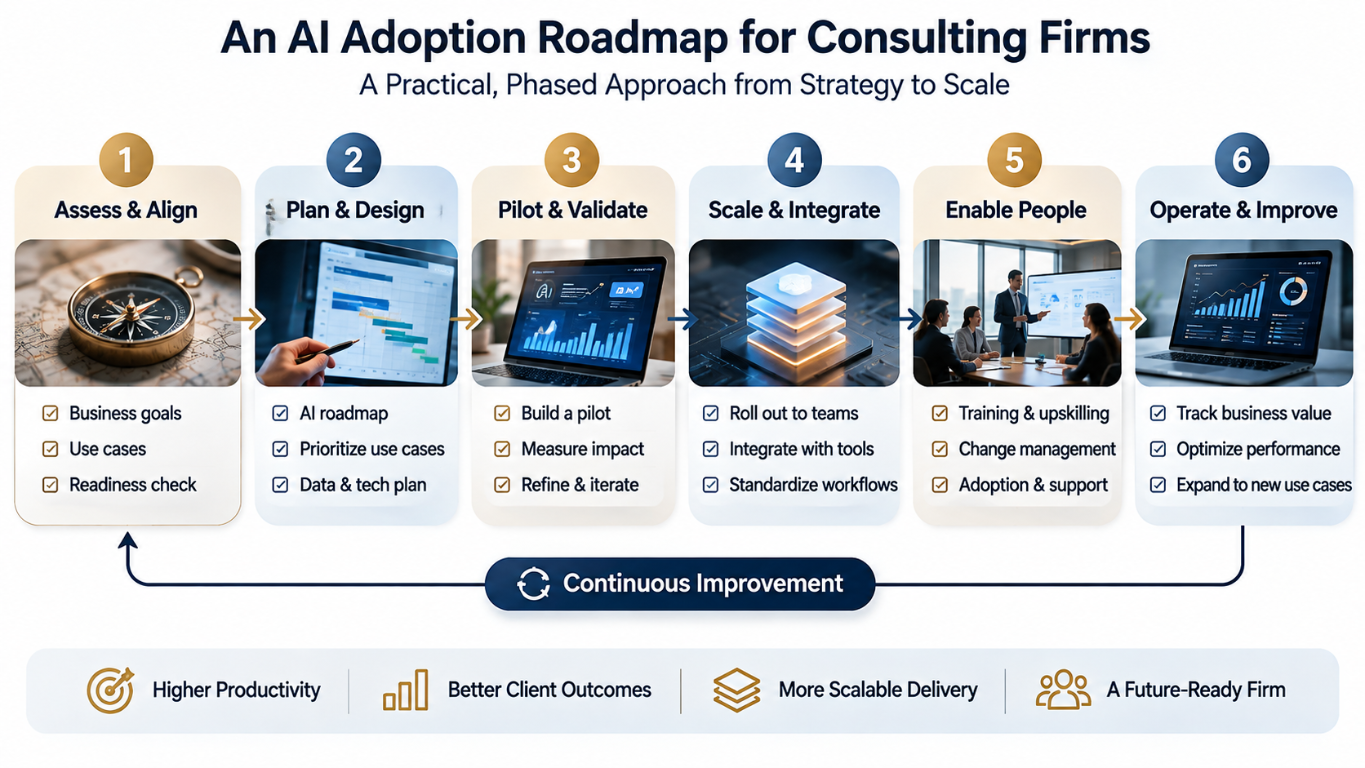
A useful ROI case helps a firm decide whether to invest and what evidence to collect next. It is not a marketing number. For a practical sequence to generate that evidence, see the AI adoption roadmap for consulting firms.