An AI research tool can make a first pass through a large body of material easier. It cannot remove the need to decide whether the sources are relevant, whether evidence supports a conclusion, or whether the firm is authorized to use the information in that way.
For consulting teams, the right evaluation is a workflow test—not a feature checklist. Use the same questions, inputs, and review criteria for each candidate.
Start with the research task
“Research” can mean finding a fact in approved internal documents, surveying public sources, summarizing interview notes, or preparing a market landscape. Those tasks have different data, source, and verification requirements.
Write one short brief for the task you want to improve. Include the input type, intended output, current process, user, reviewer, and the decision the research supports. This keeps the evaluation from drifting toward the most impressive demo.
Compare tools on the same criteria
| Criterion | What to test | Useful evidence |
|---|---|---|
| Source traceability | Can a reviewer reach the cited page, passage, or original file? | Correct, specific citations on realistic questions |
| Coverage | Does it find relevant material without overlooking important sources? | Results checked against a manually prepared reference set |
| Synthesis quality | Does the summary retain qualifications, dates, and disagreement? | Reviewer notes on omissions and distortions |
| Confidentiality and access | Can the workflow meet the firm’s information-handling rules? | Documented controls and approved account configuration |
| Workflow fit | Does it connect to the files and steps consultants already use? | A completed task, including export and handoff |
| Verification effort | How much work remains before a consultant can rely on the result? | Time spent checking, correcting, and finding original evidence |
| Operating cost | What are the subscription, usage, administration, and review costs? | A realistic estimate for the target team and task |
Ask vendors for current documentation about data handling, retention, access controls, and the features included in the proposed plan. Terms and capabilities change, so verify them directly before purchase. This guide does not endorse a particular vendor.
Run a fair pilot
Choose a small set of realistic research questions. Include simple lookups and cases where sources conflict, use different terminology, or contain caveats. For internal search, use a test collection that the firm is permitted to process and that represents how documents are actually organized.
For each tool, record whether the answer is correct, whether the cited source supports it, what was missed, and how much reviewer correction was needed. Keep a human researcher responsible for validating the result. If the task involves sensitive information, first confirm the permitted data and account with the appropriate owner.
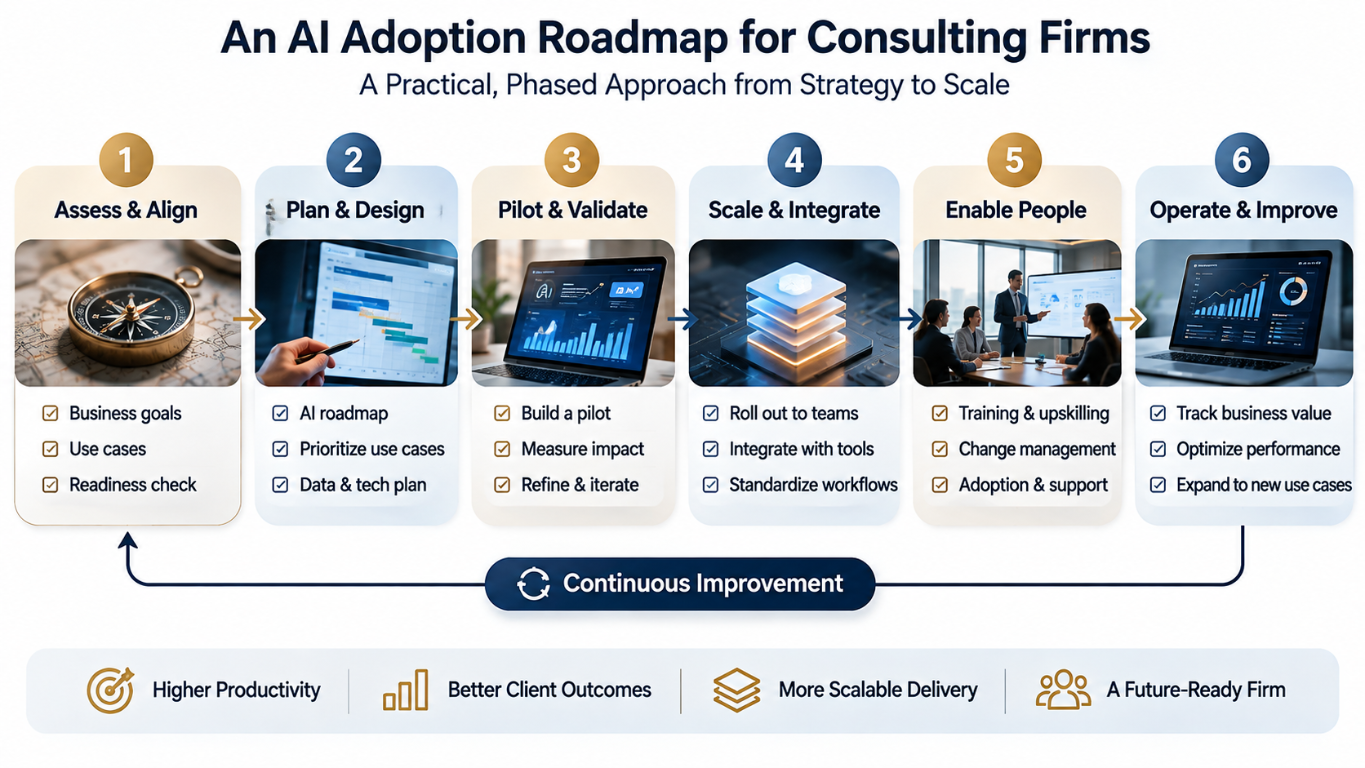
The AI adoption roadmap for consulting firms explains how to set up a bounded pilot.
A scorecard that does not hide trade-offs
Rate each criterion from 1 to 5, but keep the evidence beside the score. Do not average away a critical failure: a tool that fails the firm’s data requirements should not become the winner because it performs well on interface design.
Use three decision labels:
- Must pass: confidentiality, access, and source traceability requirements.
- Must be useful: output quality, workflow fit, and verification effort.
- Trade-offs to discuss: cost, breadth of features, and implementation effort.
The scorecard should help a team explain its choice, not create false precision. If no candidate meets the must-pass requirements, the sound decision may be to delay, narrow the task, or improve the underlying knowledge base first.
Look beyond the answer box
Research work includes finding sources, preserving context, sharing a working draft, and keeping a defensible record of what informed a recommendation. Test these handoffs. Check how a user can return to the original material and whether colleagues can review the same evidence.
Also test the failure path. What happens when the source is missing, the question is ambiguous, or the tool gives a confident but unsupported response? A well-designed process makes it easy to pause and go back to primary material.
Choose for a workflow, not for novelty
The best-fit tool is the one that supports a specific, permitted research task with acceptable evidence quality and review effort. It may be a specialist research platform, an internal knowledge search tool, or a more conventional database with no generative layer. Compare options against the same task and keep a person accountable for conclusions.
For a broader view of the systems that support engagements, see the consulting technology stack guide.